The Music Hadn't Started Yet!
- Amir Zinati

- 3 days ago
- 4 min read
The Music Hadn't Started Yet
A few months ago, on one of those sunny Vancouver autumn afternoons, I met with Hossein Meimani, founder of Anchor Art Productions.

Hossein is a friend, and for a while, I had been seeing him talk about a project called Reng-e Farah. Knowing the way he approaches music, I was curious. We sat down and talked about the event, the music, the venue, and the experience he hoped people would leave with.
At the time, I didn't know exactly what Reng-e Farah would become. I only knew there was an idea behind it that stayed with me.
What stayed with me was the feeling that, for a few hours, things that normally drift apart were being brought back into the same room.
The experience itself started long before the musicians entered the studio.
Walking through the heart of Vancouver, you eventually arrive at a brick building with a large industrial door waiting behind it. You climb the stairs and step into a space that immediately feels different.
The Pop & Chill team had transformed the entrance area with Persian rugs, Sharbat, wine, and small bites. Friends were catching up. New conversations were starting. Familiar faces mixed with people attending for the first time.
All these elements were working together, acting as a bridge to connect everyone in the room. Near the entrance, under a soft red light, there was a large board with a simple question that seemed to capture the collective mood:
"For me, home sounds like..."
People stopped. Thought for a moment. Then started writing. Some wrote about family. Some wrote about cities they had left behind. Some wrote about sounds they hadn't heard in years.
I wrote: "For me, home sounds like my father on weekend mornings."
Nobody seemed in a rush. The music hadn't started yet, but the evening—and that deep sense of connection- was already unfolding.
Eventually, we were invited inside.
It was my first time stepping into a professional recording studio. A room where countless albums had been recorded. A room built for musicians, producers, and engineers. A room that most listeners never get to enter.

That evening, we sat right in the middle of it.
The chairs formed a circle. The musicians stood at the centre. Headphones waited on every seat.
Then everything became quiet. The kind of quiet that only exists right before something begins.
Monicki Firouzmand, Amin Rezakhani, Rasoul Mahaki, Bijan Rahmani, and Hossein Meimani took their places. The headphones went on.
And suddenly the distance disappeared.
The music felt closer. The voice felt closer. Even silence felt closer.
You could hear details that would normally be lost in a concert hall. The texture of a voice. The movement of a hand. The breath before a phrase. Played from mere feet away, the notes felt incredibly intimate.
For a while, I stopped thinking about the format, the concept, and the venue. I simply listened.
And maybe that was the point.
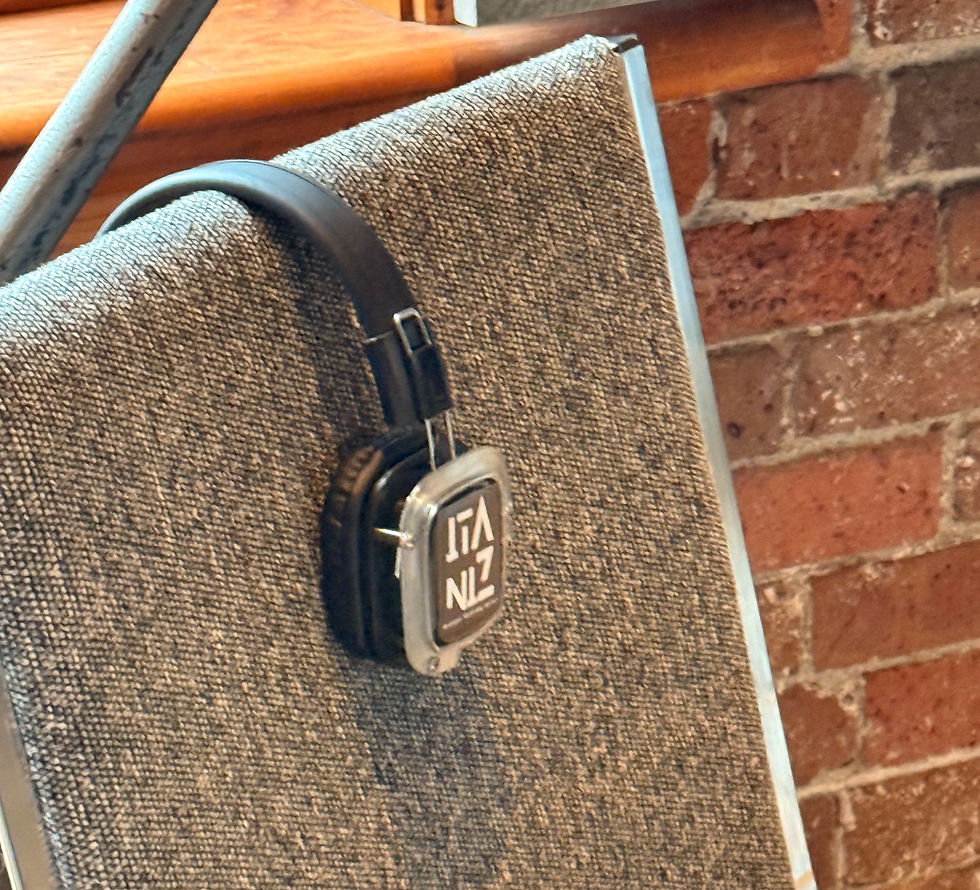
Twenty-two days before the performance, ITANIZ joined the project as the Marketing and Communications Partner.
From the beginning, our challenge was never really about promoting an event. It was about helping people understand something they had probably never experienced before.
Most people know what a concert is. Most people know what a recording studio is. Very few know what it feels like to sit inside the recording process itself.
So instead of focusing only on announcements and ticket sales, we focused on context.
We introduced Warehouse Studio and its history. We sat down with Hossein to talk about the idea behind Reng-e Farah. We interviewed Monicki and other members of the ensemble. We spoke with the Pop & Chill team about the role they would play in shaping the evening.
The goal was simple: help people understand what kind of experience was waiting for them before they walked through the door. We brought this context to life across every touchpoint, from deep-dive editorial emails and documentary-style video interviews to organic social media storytelling. We wanted the social architecture of the evening, the proximity and connection felt inside the studio, to begin taking shape within our communication long before the first guest arrived.
By the end, the 7 PM performance sold out, and the 5 PM performance reached near capacity. The content travelled far beyond the immediate community, partnerships came together, and the room was full. But numbers are not what I remember when I think about Reng-e Farah.
I remember a room full of people reflecting on home. I remember walking into Warehouse Studio for the first time. I remember putting on a pair of headphones and hearing music from a distance that felt unusually close.
And I remember leaving with the feeling that there should be more nights like this. because they create something increasingly difficult to find: a reason for people to gather around the same story, in the same room, for a few hours.
Today, the full recording of Reng-e Farah is available online.
As I look back on the evening, I find myself thinking less about what happened and more about what could happen next. I'd love to hear more about the recording process itself. I'd love to spend more time inside the creative decisions behind the music. And honestly, I'd love the evening to be longer.
Because some experiences stay with you after they end. For me, Reng-e Farah was one of them.


Comments